Lessons I have learned about life behind the camera. Some how to articles, some lessons learned the hard way, some gear reviews. Read along and let's see what develops. Full of bad puns and hopefully some wisdom, I hope this blog gets lots of exposure and you don't shutter too badly at the jokes. (see- told ya) It also will hopefully zoom in and focus your attention to my web site, http://hiddenhillsphoto.com where you can see the my work develop.
Sunday, January 5, 2014
Would you like fries with that image? Learning to learn from any job.
Ok, last post wasn't planned and was pretty negative, don't want to leave that up on top of the heap for too long, so here is another update. I am just finishing up my first well paying contract shooting assignment. Nothing glamorous, I am going around San Diego taking pictures of various storage facilities for a nationwide advertising firm that is pretty much positioning themselves as the Hotels DotCom of storage units. Not a very glamorous assignment but it pays pretty well, enough so that by the time I am done I will almost be able to get either a D800 secondary body or some studio strobes, or even pay for a couple of months of childcare if I am really feeling froggy.
Prior to this assignment the only paying gigs I have gotten are McSportrait gigs shooting posed kids kids at sports tournaments and also shooting a couple of soccer tournaments. I have to say this storage gig is a step up from the McSportrait gigs. (ps- I think I should copyright the McSportrait name I gave those gigs, how's that for a corporate name?) Shooting the actual tournament did require some skill and decent gear, that was a challenge and I would do that again. Covered that assignment in an earlier post so I won't rehash that here. The McSportrait gig was specifically designed to require as little skill or artistic ability whatsoever. There was a posing guide for exactly how to set each shot up and they actually wanted pop-up or on camera undifused flash. Taking longer than about 1 minute with each kid was considered failure. But wait, you cry, this is supposed to be about learning from any job, so what did I learn from the McSportrait gig? A couple of things: First, the small paycheck and complete lack of any ability to try and take a good picture were not worth the time away from my family. So I learned about setting boundaries and not just taking any job that came my way in order to get a paltry paycheck. There is something to be said for working in the trenches and putting in time on the bottom to grow and learn, but this wasn't it. This job taught me to really think about it and try to learn the difference between a job that offered growth opportunities and one that was not worth it. Second, I learned that unless it's my own, I do not really enjoy working with kids until they get to about high school age. That pretty much rules out several large fields of work I could otherwise have potentially wasted my own time and energy making a run at.
So what about the storage assignment? I took it mainly because it was something new that I hadn't tried yet and it looked like it paid well relative to the time/energy commitment. I thought it would be a bit easier and less enjoyable that it has turned out to be so far. At first I thought it was just going to be a better paying version of the McSportrait gig, with buildings instead of kids. But a few facilities into it I figured out it was more than that. It's my introduction to the field of architectural photography and it is clear that I have a lot to learn about this field. Each location, although similar in concept, is quite different in lots of key ways: layout, lighting, colors, etc. The challenge is to take the same boring pics at each facility but still find a way to convey a feel of the place while showing it in the best possible way. In other words, how to make the boring interesting. I am also getting a crash course in shooting wide angle and having to deal with converging lines, straight horizons, lens distortion, shooting angles and all the other challenges that come with shooting wide. I am also having to deal with shooting at the limits of the D4's dynamic range; since the only times the offices are open is the middle of the day, I get the fun of shooting from an extremely bright and sunny exterior into completely dark, cavernous storage units without time to set up a tripod and go HDR. I also decided I would shoot everything in full manual mode so I am getting a lot of practice adjusting for different lighting conditions, picking a metering method and paying attention to the meter.
But by far the biggest learning curve on this one has been workflow management and efficiency. I get paid on a per facility basis, not a time scale. So the more efficient I can make my workflow, the more profitable it is for me. Even more than just the money, lack of an efficient workflow would drive me nuts on this job and could cause embarrassing errors. I am shooting 5-10 facilities a day, so I need to workflow that lets me keep track of which shots are of which facility, which facilities I have shot and which I haven't, naming and key wording files on import, editing as rapidly as possible, client delivery and an accurate invoicing so I can get paid promptly and correctly. This has been the biggest learning curve for me. I think I have a flow now that works pretty well, I have only had to unscrew myself a few times when I mislabeled a few shots during upload. And I also learned that shooting architectural shots is fun and seems to pay well. I will have to do a lot more research and learning in the field and see what happens.
But really, what I wanted to say is that no matter how mundane you think the work you are doing is, there is something there to learn and a way to use the experience to grow, even if you don't see it at first. There is always a different perspective if you can learn to see it.
Friday, January 3, 2014
Well, that was interesting. Banning my first troll and RAW Artists revisited
It's been an up and down week. I got a great Christmas present- on Christmas day I got a positive comment on one of my posts here from a reader in Australia. I joke over and over about the three of my friends who read this blog regularly- I never expected to be an internet sensation, but it felt surprisingly good to find out that there are literally people around the world reading what I write and likeing it.
Turns out that not all those readers are fans. A while back I wrote up a post about my first show, with a group called RAW Artists. This post has been one of the ones most frequently linked to via Google searches as a pipeline into my blog. Lots of artists are apparently wanting to learn mroe about RAW. And some apparently have had a different experience with them than I did. When I logged onto my Facebook page this evening I had an interesting series of comments and links posted from someone who seems to exist on FB totally as a foil to RAW Artists. His original comment was on one of the automatic post links that goes up on my FB page when I make a blog post. Interestingly enough, the post he attached his scathing commentary to was not the RAW Artists post, but rather was attached to a post I wrote expressing my admiration for another photographer's support of marriage equality. In this reader's eyes, I am a "troll" which is interesting, because he was the one posting scathing comments and useless links on my page. I am also a "gullible amateur artist."
Let's dissect those critques: Am I am amateur? Well, this blog was set up from the get go as a chronicle of my attempts to transition from a part time hobbiest to professional shooter. Am I Ansel Adams? No, nor have I ever claimed to be. Do I make my living solely from my camera? No, I do not. Have I been paid for my photographic work? Not a lot, but yes, I have. A few people have ordered prints from shoots, and I am about halfway through my first contract gig doing some architectural photography around San Diego. Do I still consider myself an amateur? Yes. Guilty as charged on that count, but I don't take that label as the insult it was clearly intended to be. I know I am not there yet, that is why I am putting in the work and learning as I go, I don't expect to be the best in the world right out of the gate. Which leaves the charge of "gullible." Apparently this respondent did not bother to read my article at all. From the initial contact RAW made to me, there were no lies, no dissemination, no false expectations set at all. I even referenced the article he so handily posted a link to on my page (along with a suggestion that I do more research... I do so love irony...) which talks about RAW being a scam. His FB page and the articles he linked to basically boil down to the single complaint that RAW is somehow deceiving artists in order to bilk us out of our hard earned money. My short answer is, "WHAAAAAA- you want some cheese to go with that whine?"
But I will give him the benefit of the doubt. Maybe in other markets the coordinators use more devious and underhanded tactics. All I can speak about from my first hand knowledge is the San Diego area and the team who was running the event I did last year. After I contacted them in response to an ad they placed looking for artists for a local show, they "deviously" explained to me that to participate I would be on the hook for a fee (I think it was $300 total, can't remember for sure). I could either sell tickets to the show and pay the fee that way or if not, I would be responsible for paying the difference between the total and however many tickets I was able to sell. Any tickets sold over that minimum would be theirs, not mine. In return I would get space at the event, advertising along with the event marketing and photo and video from the event for my personal use. That's it. Not really sure where the deception or gullibility comes in. I knew exactly what I signed up for and RAW delivered exactly what they promised they would deliver on their end.
Since then I have looked at a quite a few pages and statements from people who have been "scammed" by RAW. Their complaints basically boil down to the shocking revelation that there are corporations out there that seek to make money off the work of artists. Surely, this is earth shatterring news, I can't understand for the life of my why it isn't the lead story on every major news outlet. Companies trying to make a profit off the work of artists? That model is truly a rarity in this world. Good thing major record labels, movie studios and book publishers never work that way.
Wow. I never thought I would hit this moment, but I may have hit my maximum sarcasm potential, at least as much sarcasm as I can find a way to put into a print medium without vocal inflection and non-verbal cues. Seriously, you had a bad experience with RAW, you feel that anyone and everyone should be paying you for the priviledge of viewing your work. I get that. But get off my back. I knew exactly what I was signing up for when I said that I would do the RAW show. They promised me nothing that they didn't deliver on. They didn't make me a star, but I didn't expect that they would. I wanted some exposure, I got that. I had a great night overall, made some contacts and have gotten some follow on gigs from those contacts.
Ok. It's obvious from my rant above that I maybe took this commentary a little too personally. I have learned over the past few years that I shouldn't worry about what other people think of me and how they act towards me. I can't control that, all I can control is my reaction to it. I will choose to see the positive and be happy that the fact that I have been trolled means people are taking notice. And I am pretty sure there has never been a recorcded instance in history of an artist that didn't have scathing critics at some point. So I will take it as a sign of progress.
Finally, in the interests of fairness, since I have removed both the comments and links from my FB page since that site is designed basically as advertising and promotion and not a place for flame wars, I will post links to the site of the posted and to the "info" sites he linked me to so you can check them out if you want and make your own decisions.
https://www.facebook.com/anthonyxmountain
http://www.merylpataky.com/my-raw-artists-experience.html
So decide for yourselves. Me, I am competely unsurprised that a corporate entity is happy to make money off of my attempts to grow as an artists. I expect it. As long as they deliver on what they said they would, I don't expect anyone to go the extral mile to help me out. I fully expect that before I make it as a professional, I will have to invest a lot of my hard earned money and my insufficient supplies of time and personal energy in variuous ways chasing my dream. There is no art without loss and sacrifice. I can live with that and the circus has made me tough enough to take some pain in search of art. (ok- by some, I mean a lot, my fellow aerialists know what I mean) That being said- if anyone finds that mythical unicorn of a promotion company that really wants to give every dollar they earn back to supporting my art, and pay out large amounts of money to help unknowns like me get national exposure, please send me their info.
Turns out that not all those readers are fans. A while back I wrote up a post about my first show, with a group called RAW Artists. This post has been one of the ones most frequently linked to via Google searches as a pipeline into my blog. Lots of artists are apparently wanting to learn mroe about RAW. And some apparently have had a different experience with them than I did. When I logged onto my Facebook page this evening I had an interesting series of comments and links posted from someone who seems to exist on FB totally as a foil to RAW Artists. His original comment was on one of the automatic post links that goes up on my FB page when I make a blog post. Interestingly enough, the post he attached his scathing commentary to was not the RAW Artists post, but rather was attached to a post I wrote expressing my admiration for another photographer's support of marriage equality. In this reader's eyes, I am a "troll" which is interesting, because he was the one posting scathing comments and useless links on my page. I am also a "gullible amateur artist."
Let's dissect those critques: Am I am amateur? Well, this blog was set up from the get go as a chronicle of my attempts to transition from a part time hobbiest to professional shooter. Am I Ansel Adams? No, nor have I ever claimed to be. Do I make my living solely from my camera? No, I do not. Have I been paid for my photographic work? Not a lot, but yes, I have. A few people have ordered prints from shoots, and I am about halfway through my first contract gig doing some architectural photography around San Diego. Do I still consider myself an amateur? Yes. Guilty as charged on that count, but I don't take that label as the insult it was clearly intended to be. I know I am not there yet, that is why I am putting in the work and learning as I go, I don't expect to be the best in the world right out of the gate. Which leaves the charge of "gullible." Apparently this respondent did not bother to read my article at all. From the initial contact RAW made to me, there were no lies, no dissemination, no false expectations set at all. I even referenced the article he so handily posted a link to on my page (along with a suggestion that I do more research... I do so love irony...) which talks about RAW being a scam. His FB page and the articles he linked to basically boil down to the single complaint that RAW is somehow deceiving artists in order to bilk us out of our hard earned money. My short answer is, "WHAAAAAA- you want some cheese to go with that whine?"
But I will give him the benefit of the doubt. Maybe in other markets the coordinators use more devious and underhanded tactics. All I can speak about from my first hand knowledge is the San Diego area and the team who was running the event I did last year. After I contacted them in response to an ad they placed looking for artists for a local show, they "deviously" explained to me that to participate I would be on the hook for a fee (I think it was $300 total, can't remember for sure). I could either sell tickets to the show and pay the fee that way or if not, I would be responsible for paying the difference between the total and however many tickets I was able to sell. Any tickets sold over that minimum would be theirs, not mine. In return I would get space at the event, advertising along with the event marketing and photo and video from the event for my personal use. That's it. Not really sure where the deception or gullibility comes in. I knew exactly what I signed up for and RAW delivered exactly what they promised they would deliver on their end.
Since then I have looked at a quite a few pages and statements from people who have been "scammed" by RAW. Their complaints basically boil down to the shocking revelation that there are corporations out there that seek to make money off the work of artists. Surely, this is earth shatterring news, I can't understand for the life of my why it isn't the lead story on every major news outlet. Companies trying to make a profit off the work of artists? That model is truly a rarity in this world. Good thing major record labels, movie studios and book publishers never work that way.
Wow. I never thought I would hit this moment, but I may have hit my maximum sarcasm potential, at least as much sarcasm as I can find a way to put into a print medium without vocal inflection and non-verbal cues. Seriously, you had a bad experience with RAW, you feel that anyone and everyone should be paying you for the priviledge of viewing your work. I get that. But get off my back. I knew exactly what I was signing up for when I said that I would do the RAW show. They promised me nothing that they didn't deliver on. They didn't make me a star, but I didn't expect that they would. I wanted some exposure, I got that. I had a great night overall, made some contacts and have gotten some follow on gigs from those contacts.
Ok. It's obvious from my rant above that I maybe took this commentary a little too personally. I have learned over the past few years that I shouldn't worry about what other people think of me and how they act towards me. I can't control that, all I can control is my reaction to it. I will choose to see the positive and be happy that the fact that I have been trolled means people are taking notice. And I am pretty sure there has never been a recorcded instance in history of an artist that didn't have scathing critics at some point. So I will take it as a sign of progress.
Finally, in the interests of fairness, since I have removed both the comments and links from my FB page since that site is designed basically as advertising and promotion and not a place for flame wars, I will post links to the site of the posted and to the "info" sites he linked me to so you can check them out if you want and make your own decisions.
https://www.facebook.com/anthonyxmountain
http://www.merylpataky.com/my-raw-artists-experience.html
So decide for yourselves. Me, I am competely unsurprised that a corporate entity is happy to make money off of my attempts to grow as an artists. I expect it. As long as they deliver on what they said they would, I don't expect anyone to go the extral mile to help me out. I fully expect that before I make it as a professional, I will have to invest a lot of my hard earned money and my insufficient supplies of time and personal energy in variuous ways chasing my dream. There is no art without loss and sacrifice. I can live with that and the circus has made me tough enough to take some pain in search of art. (ok- by some, I mean a lot, my fellow aerialists know what I mean) That being said- if anyone finds that mythical unicorn of a promotion company that really wants to give every dollar they earn back to supporting my art, and pay out large amounts of money to help unknowns like me get national exposure, please send me their info.
Wednesday, January 1, 2014
Pros Show Up! Persistence is rewarded and a little Burlesque to start off the New Year!
![]() |
| The Lovely Nina Bel Vande! |
At least, that's what I was telling my self last weekend. I had just gotten back from an exhausting trip home to New Orleans. My entire family was sick and pretty much the only things keeping me standing were Dayquil and an endless supply of cough drops. Needless to say, I wasn't as excited about a 45 minute drive each way late at night, dealing with weekend parking in a busy neighborhood and shooting a non-paid gig as I normally would have been, especially since it is a regular show, one I have shot before and will again. I also knew that one of my favorite people to hang out with at these shows, fellow photographer Deborah Divis of Fantasies' Muse, was out of town for the holiday and wouldn't be there. But, it was a birthday show for a really good friend of mine, an amazing performer and simply one of the most awesome people I know, and somewhere in the myriad of things I read on photography and life in general, I remembered reading something about the difference between a pro and a wanna be is that the pro always shows up.
The hobbyist shoots when it's convenient but stays home when things aren't going their way. The Pro is the one that soldiers on when it isn't easy, and still gets the shot. It's like pro sports. Sure, some are born with natural talent, but in general if you look into the story of any pro player, you'll find that what got them to the big game wasn't the talent they were born with, it was years of slugging it out, day in and day out on the practice field. Practicing until they couldn't keep going anymore. Same for musicians, painters, pretty much any artistic discipline. You stick with it and make yourself do it, even when it's hard, and trust the universe to reward persistent efforts aimed towards improvement. So I sucked it up, packed the camera bag, made sure my partner was really cool with staying home alone with the sick kid (pushing myself is one thing, leaving her on the hook is different, but I have the most awesome and supportive woman ever) and headed down to the show.
Wound up really glad I did. The acts were excellent, as always. If anything, even better because there was a quite a bit of over the top sacrilegious humor that I really appreciated. A friend from Trapeze that I didn't expect to see showed up to see the show as well as a few other cool people I hadn't seen in a while, so I had a good time catching up with them and hanging out. Overall, the shots I took at this show were the best set I have captured so far from this crew/venue. Part of it is me getting better, but part of it is also the club. I have ranted about the Brass Rail's lighting before, but I have to say it has been getting better, and this show was the best lit one I have seen at the rail. You can see the full gallery of the show here.
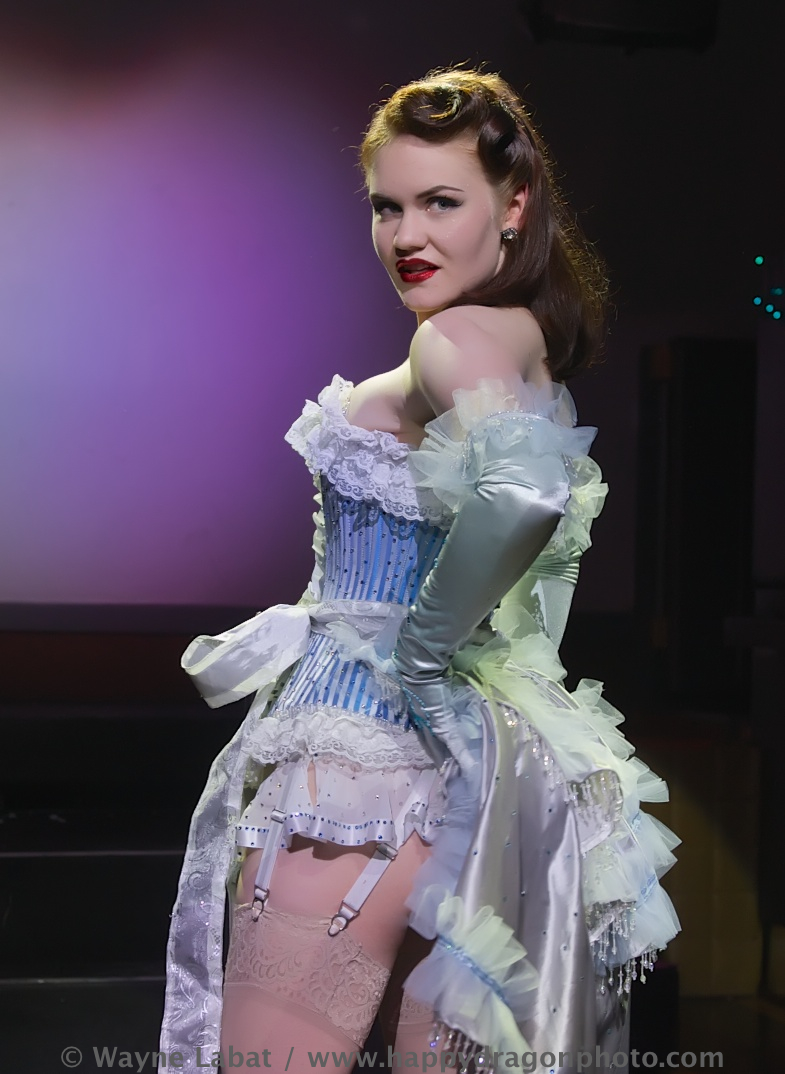
But what really made the night for me was a single act from a performer I hadn't seen before. Pink Boom Box is mostly neo-burlesque with a more circusy flair. Which is awesome. But I am still a fan of the classics. Some of the artists do more classic routines at times, but generally it's pools of blood on stage, gas masks, aerial and fire dance, etc. In the generally poor light the club has used in the past. This time the stars aligned. Beautiful performer with a classic burlesque look in a classic style costume doing a classic routine, set up perfectly where the new brighter club lights were focused so that not only was she well lit but the background was also lit with some great color. She gave the audience some pinup poses throughout the routine and held them just long enough for the shutter to work. Actually, about the only thing I can say that I would have liked to see was more of her eyes, but I was down low and not the only audience, so I guess I can't have it all. I have lots of great shots of beautiful performers, but this series I got was the first time I felt like everything came together and I was able to get a really old school set of burlesque shots to throw into my portfolio.
So, some of my favorite burlesque shots ever from a night where the whiney voice in my head was yelling at me to stay in and not bother. I am learning to listen to my instincts and rely on my inner voice a lot more than I used to, but it's also just as important to learn when to tell it to shut up and let you do what you need to do. Pros show up and shoot. Persistence and a constant drive for improvement will be rewarded in the long run. Coming into what I hope will be a growth year for me in lots of areas, including my photography, so it's good to be reminded that continually putting in the effort and the work can lead to a happy ending. Happy New Year Everyone!
Saturday, December 28, 2013
Going home, giving a little back and the importance of reading the manual!
Went home to New Orleans for Christmas. Decided to travel light, so I brought the bare minimum. One body, two lenses, a single speed light, spare batteries and cards. No computer. I would have just gone with a single lens and lived with nothing but the 24-70mm but I knew that I was going to want the 14-24mm while I was walking around the French Quarter. I had a lot less time to wander around shooting than I planned on getting because the entire family came down with some sort of plague while we were there, but did get to shoot a little. Mostly I just got standard postcard FQ shots, nothing ground shaking.
My favorite series from the quarter happened at random. I took the family to Cafe du Monde for beignets and coffee, and had to make a trip to the restroom. There was quite a long line, so I just kept he camera up and shot while I waited. Wound up with a sort of behind the madness sort of series of shots that I really like.
Also, as I mentioned on Facebook while I was there, I actually saw a guy walking around shooting with an honest to goodness Rolleiflex camera. I didn't know any of those were still actually in working condition, prior to this I had only seen them in old busted gear collections. I thought at first that it was one of the newer digital era models, but no, it was the old school real deal. He wasn't even an annoying hipster- you never know what you will see in New Orleans.
On the way home after our first trip out, my mom asked if we wanted to stop in at her church and see the Christmas Story performance put on by the kids group she works with. I have spent quite a few years trying to undo the damage that years of church brainwashing starting in my childhood did to me and I have no wish to inflict that same damage on my own child. But it was Christmas, how could I tell mom no? So we went. Her group takes care of some low income children a few afternoons a week when their parents can't get out of work in time to pick them up from school. This being a Thursday afternoon, those parents were still at work, so the audience for the kids' performance consisted of my family and the program personnel. That made me feel kind of bad that the kids would't get to show off for their parents, but I realized I had the means to fix that, at least a little bit. Ran back out to the car and grabbed the camera.
Of course, since I hadn't planned on pulling any shots off the memory cards until I got home, I hadn't brought my computer with me. This meant I had to re-plan my workflow on the fly if my mom was going to be able to get the images to the kids before Christmas. No problem, I switched the primary card to CF since most places don't have XQD readers and set to shoot RAW + JPEG Fine. That way I figured I would be able to go anywhere locally, pull the JPEGs off the card to burn to a CD for mom, then do real editing on the RAW images when I got home. Since I was relying on the in camera conversions, I stuck with a fixed white balance so all the shots would be consistent.
While this worked for most of the images, I must confess that I made a stupid mistake at the end. After the show, they wanted to get a few group shots, so I decided to drop the ISO down and slap a speed light on top for some fill. Can you guess what happened? Yup, forgot to switch the white balance from tungsten to flash, so the in camera JPEGs looked like I was shooting a group of ghosts. No bueno. Rookie mistake, something I could easily fix on the raw images at home, but that didn't help me with the JPEGs I needed to pull for mom. So, lesson one is: Pay attention to what you are doing. Since I failed to follow that advice this time, I needed a save. Luckily, I remembered lesson two, which is today's public service announcement:
Time for an aside for today's lesson. When you get a new piece of gear, read the manual! Seriously. Even if you have been a pro shooting for years, chances are there is some new feature you would never know about buried somewhere in a nest of menus on your new toy. The D4 is an amazing machine, it has more onboard processing power than most of the computers I have owned in the past- it has its' own network server for crying out loud- seriously. So at least skim through the manual when you get a new toy. Look back at it frequently as you move into new techniques of shooting. When I first started messing with star trails and time lapses, searching the internet to read about techniques made me think I would need cable releases, intervalometers and all sorts of extra gadgetry. Not so much. Luckily I read read the manual and found out all those bells and whistles are already built into the D4. So reading the manual can save you money as well as saving your ass.
But in this case, for this shoot, it just saved my ass. Since I had skimmed the manual, I knew that the D4 was able to do a fair amount of in camera editing on images, but since I had never used any of that functionality, I had no idea how to even start. Rather than spending a frustrating hour of trial and error and possibly losing an image, I pulled out my handy manual and read the right sections.
What? You don't carry your manual out into the field with you? Shame on you. I know, I said at the start I was traveling light. But it doesn't get any lighter than a PDF on my iPad. If you happen to have the Nikon/Ipad combo like me, it's ridiculously easy to carry your manuals with you. There is an App called "Nikon Manual Viewer" that you can use to download and store any manuals or setting guides Nikon publishes and have them with you anywhere, anytime. (The app also works on an iPhone, but it's wayyyyy easier to read the manuals on the larger iPad screen) Whether cannon has a similar setup or not, it is pretty easy to find pdf copies of manuals for any product out there and you can view them on almost any platform, so there really is no excuse for not having the reference on hand.
Anyway, the manual saved the day and in about 30 seconds I had corrected the white balance on the group shots and was able to put everything on a CD for my mom to give images to the parents in time for Christmas.
Anyway, I got some cute shots that I hope the parents will enjoy and it felt good to use the camera to give a little back. I know my mom appreciated it.
So now I am home, recovering from the plague, still going through the rest of my images from the trip. There will be at least one more post coming from the New Orleans images, but since this is my Christmas post, I will end with the obligatory shot of a christmas tree, at least how one looks with one of my brother's blue pint glasses stuck over the end of my lens. What can I say, NyQuil leads to interesting creative efforts.
Anyway, Happy Christmahanakwanzika and Merry New Year! See you in 2014!
![]() |
| Jackson Square and St. Louis Cathedral |
![]() |
| Christmas, French Quarter Style |
My favorite series from the quarter happened at random. I took the family to Cafe du Monde for beignets and coffee, and had to make a trip to the restroom. There was quite a long line, so I just kept he camera up and shot while I waited. Wound up with a sort of behind the madness sort of series of shots that I really like.
Also, as I mentioned on Facebook while I was there, I actually saw a guy walking around shooting with an honest to goodness Rolleiflex camera. I didn't know any of those were still actually in working condition, prior to this I had only seen them in old busted gear collections. I thought at first that it was one of the newer digital era models, but no, it was the old school real deal. He wasn't even an annoying hipster- you never know what you will see in New Orleans.
On the way home after our first trip out, my mom asked if we wanted to stop in at her church and see the Christmas Story performance put on by the kids group she works with. I have spent quite a few years trying to undo the damage that years of church brainwashing starting in my childhood did to me and I have no wish to inflict that same damage on my own child. But it was Christmas, how could I tell mom no? So we went. Her group takes care of some low income children a few afternoons a week when their parents can't get out of work in time to pick them up from school. This being a Thursday afternoon, those parents were still at work, so the audience for the kids' performance consisted of my family and the program personnel. That made me feel kind of bad that the kids would't get to show off for their parents, but I realized I had the means to fix that, at least a little bit. Ran back out to the car and grabbed the camera.
Of course, since I hadn't planned on pulling any shots off the memory cards until I got home, I hadn't brought my computer with me. This meant I had to re-plan my workflow on the fly if my mom was going to be able to get the images to the kids before Christmas. No problem, I switched the primary card to CF since most places don't have XQD readers and set to shoot RAW + JPEG Fine. That way I figured I would be able to go anywhere locally, pull the JPEGs off the card to burn to a CD for mom, then do real editing on the RAW images when I got home. Since I was relying on the in camera conversions, I stuck with a fixed white balance so all the shots would be consistent.
While this worked for most of the images, I must confess that I made a stupid mistake at the end. After the show, they wanted to get a few group shots, so I decided to drop the ISO down and slap a speed light on top for some fill. Can you guess what happened? Yup, forgot to switch the white balance from tungsten to flash, so the in camera JPEGs looked like I was shooting a group of ghosts. No bueno. Rookie mistake, something I could easily fix on the raw images at home, but that didn't help me with the JPEGs I needed to pull for mom. So, lesson one is: Pay attention to what you are doing. Since I failed to follow that advice this time, I needed a save. Luckily, I remembered lesson two, which is today's public service announcement:
READ THE MANUAL!
Time for an aside for today's lesson. When you get a new piece of gear, read the manual! Seriously. Even if you have been a pro shooting for years, chances are there is some new feature you would never know about buried somewhere in a nest of menus on your new toy. The D4 is an amazing machine, it has more onboard processing power than most of the computers I have owned in the past- it has its' own network server for crying out loud- seriously. So at least skim through the manual when you get a new toy. Look back at it frequently as you move into new techniques of shooting. When I first started messing with star trails and time lapses, searching the internet to read about techniques made me think I would need cable releases, intervalometers and all sorts of extra gadgetry. Not so much. Luckily I read read the manual and found out all those bells and whistles are already built into the D4. So reading the manual can save you money as well as saving your ass.
But in this case, for this shoot, it just saved my ass. Since I had skimmed the manual, I knew that the D4 was able to do a fair amount of in camera editing on images, but since I had never used any of that functionality, I had no idea how to even start. Rather than spending a frustrating hour of trial and error and possibly losing an image, I pulled out my handy manual and read the right sections.
What? You don't carry your manual out into the field with you? Shame on you. I know, I said at the start I was traveling light. But it doesn't get any lighter than a PDF on my iPad. If you happen to have the Nikon/Ipad combo like me, it's ridiculously easy to carry your manuals with you. There is an App called "Nikon Manual Viewer" that you can use to download and store any manuals or setting guides Nikon publishes and have them with you anywhere, anytime. (The app also works on an iPhone, but it's wayyyyy easier to read the manuals on the larger iPad screen) Whether cannon has a similar setup or not, it is pretty easy to find pdf copies of manuals for any product out there and you can view them on almost any platform, so there really is no excuse for not having the reference on hand.
Anyway, the manual saved the day and in about 30 seconds I had corrected the white balance on the group shots and was able to put everything on a CD for my mom to give images to the parents in time for Christmas.
![]() |
| Reading the manual saves Christmas- Can I get an Amen? Hallalujah? |
Anyway, I got some cute shots that I hope the parents will enjoy and it felt good to use the camera to give a little back. I know my mom appreciated it.
So now I am home, recovering from the plague, still going through the rest of my images from the trip. There will be at least one more post coming from the New Orleans images, but since this is my Christmas post, I will end with the obligatory shot of a christmas tree, at least how one looks with one of my brother's blue pint glasses stuck over the end of my lens. What can I say, NyQuil leads to interesting creative efforts.
![]() |
| Old school instagram filters? |
Anyway, Happy Christmahanakwanzika and Merry New Year! See you in 2014!
Sunday, December 15, 2013
A different sort of engagement shoot...
I recently had the pleasure of doing my first engagement shoot for a couple of awesome friends of mine. I know the happy couple through Trapeze, the bride to be is one of the catchers at our rig, in addition to being an awesome flyer and one of my girlfriend's best girlfriends. The couple has actually known each other since junior high, but reconnected a while back and hit it off.
We were all a bit nervous when they started dating, it seems like relationships between circus people and non circus people tend to not last that long. Luckily, he jumped right in and took to trapeze really well and is now a full fledged member of the troupe.
Anyway, a couple of weekends ago we were all out for drinks, planning wedding and bachelor party / bridal shower festivities and the engagement shoot came up. I offered to do one, but we wanted to make it something unique to them. Of course, my first thought was trapeze, followed immediately by breaking into their old junior high and taking pics at some of the places they remembered from way back when. Apparently schools take security a lot more seriously these days, so that beer induced idea quickly went the way of the dodo bird. Luckily, one of their memories was of doing rings on the playground. Serendipitously we recently got a set of traveling rings built at our trapeze rig, so the next day it was game on.
The shot I really wanted was the couple bridged (ie- holding a catch mid-air) one armed, camera aside arms opened and him putting the ring on her while in the air. We weren't quite able to pull that off, closest we got to that were these:
But we did get some great shots on the traveling rings-
When the bridge thing didn't work, the bride to be had the awesome idea to just hang out in the apron for some shots, wound up being some of the best of the set....
Actually wound up passing the camera off and getting our family christmas card picture in the apron as well since these worked so well.
Even though the one shot I wanted didn't pan out, I think overall the afternoon was a success. This was definitely a fun shoot and I look forward to shooting the wedding in the near future. In the meantime, you can see the whole shoot here and let me know what you think.
Wednesday, November 20, 2013
To Photoshop or not to Photoshop, what was the question again? (aka when is photoshop cheating?)
Photoshop. Pictures altered, sometimes beyond recognition or reality, have become so prevalent that the noun has become a verb. There are some examples of amazing photo editing out there, but far more prevalent are examples of how easy it is for image editing to go hideously wrong. Photoshopped images are becoming controversial in mainstream media, even spawning an anti-photoshop movement. The question of what constitutes an authentic versus a "photoshopped" image has created a controversy in some photo competitions in the photojournalism world. So, is photoshop a useful tool, a necessary evil, the devil, or some combination thereof?
As a photographer schooled on film and relatively new to the world of serious digital photography, this is an important question for me on many levels. Initially I was very resistant to the concept, holding a somewhat self righteous idea that photoshop was what people did when they couldn't take good pictures. Actually, turns out that after some self reflection, that was just a defense I put up to justify the fact that I was merely too lazy to invest the time, money and energy into learning my way around photoshop.
There was no one key moment that triggered the introspection leading to that change in perspective, rather it was a slippery slope leading to a final plunge. It started with simple things, easy adjustments in Aperture, my catalogue software of choice. A little tweak to the exposure... then came the plug ins. A little noise reduction to make up for the high ISO I need to shoot most of my subject matter... maybe a quick plug in to smooth skin in portraits.... nothing fancy.... quite often I was left with the feeling that I could almost get the image to where I wanted, but not quite all the way. Then finally I did my first aerial studio shoot last month. It will be a few months yet before I have enough saved up to invest in some portable strobes, so I am shooting only with the two speed lights I have and a couple of umbrellas. So not enough really to light the aerialist and control the background. I was hoping it would be easy enough to fix the neutral grey back wall in aperture. Technically it was, but the only way I could find to do it was to crank the black point way up to make the background black, what you see in the image linked to above. But I had to do some exposure and other compensations to keep the aerialist decently lit after that and in a lot of the images I really didn't feel like I got them where I wanted. I was left finally with the inescapable conclusion that I needed to really learn my way around a digital darkroom.
Aperture is an amazing and highly capable program. It is capable of far more technical editing than I know how to do right now. I am going to fix that and learn to max out its' abilities. But as I looked into what I wanted to be able to do, it became obvious that I really needed to acquire and learn photoshop. It's a massive investment, both in terms of time and money. Photoshop is neither cheap, nor easy and intuitive to learn. But I decided that once again, I had to go all in and invest in myself and what I want to do. I keep finding that each time I do that, the universe backs me up and rewards me, so what the hell. It was time to invest in photoshop. Creative Cloud is a cheaper option, but it doesn't work for me because a lot of times I am out on a ship with a crappy internet connection and stuck with the work computers to get to that, so I would lose contact with the adobe server and find my programs shut off. So dropped the coin for Photoshop CS6. And some manuals. As I mentioned earlier, it is not an intuitive interface, not easily learned or something to tackle on a weekend. I think most of the books I found were written in some other language or at least assumed a strong familiarity with prior versions of photoshop. But I spend the last two weeks out to sea trying to get my head around the basics. I now possess the rough equivalent of a kindergarten level of photoshop literacy and know enough to get into trouble. Thus, I present you, the faithful reader, with this- my first "photoshop'd" image:
As a photographer schooled on film and relatively new to the world of serious digital photography, this is an important question for me on many levels. Initially I was very resistant to the concept, holding a somewhat self righteous idea that photoshop was what people did when they couldn't take good pictures. Actually, turns out that after some self reflection, that was just a defense I put up to justify the fact that I was merely too lazy to invest the time, money and energy into learning my way around photoshop.
There was no one key moment that triggered the introspection leading to that change in perspective, rather it was a slippery slope leading to a final plunge. It started with simple things, easy adjustments in Aperture, my catalogue software of choice. A little tweak to the exposure... then came the plug ins. A little noise reduction to make up for the high ISO I need to shoot most of my subject matter... maybe a quick plug in to smooth skin in portraits.... nothing fancy.... quite often I was left with the feeling that I could almost get the image to where I wanted, but not quite all the way. Then finally I did my first aerial studio shoot last month. It will be a few months yet before I have enough saved up to invest in some portable strobes, so I am shooting only with the two speed lights I have and a couple of umbrellas. So not enough really to light the aerialist and control the background. I was hoping it would be easy enough to fix the neutral grey back wall in aperture. Technically it was, but the only way I could find to do it was to crank the black point way up to make the background black, what you see in the image linked to above. But I had to do some exposure and other compensations to keep the aerialist decently lit after that and in a lot of the images I really didn't feel like I got them where I wanted. I was left finally with the inescapable conclusion that I needed to really learn my way around a digital darkroom.
Aperture is an amazing and highly capable program. It is capable of far more technical editing than I know how to do right now. I am going to fix that and learn to max out its' abilities. But as I looked into what I wanted to be able to do, it became obvious that I really needed to acquire and learn photoshop. It's a massive investment, both in terms of time and money. Photoshop is neither cheap, nor easy and intuitive to learn. But I decided that once again, I had to go all in and invest in myself and what I want to do. I keep finding that each time I do that, the universe backs me up and rewards me, so what the hell. It was time to invest in photoshop. Creative Cloud is a cheaper option, but it doesn't work for me because a lot of times I am out on a ship with a crappy internet connection and stuck with the work computers to get to that, so I would lose contact with the adobe server and find my programs shut off. So dropped the coin for Photoshop CS6. And some manuals. As I mentioned earlier, it is not an intuitive interface, not easily learned or something to tackle on a weekend. I think most of the books I found were written in some other language or at least assumed a strong familiarity with prior versions of photoshop. But I spend the last two weeks out to sea trying to get my head around the basics. I now possess the rough equivalent of a kindergarten level of photoshop literacy and know enough to get into trouble. Thus, I present you, the faithful reader, with this- my first "photoshop'd" image:
![]() |
| The original image as shot |
![]() |
| Aperture edited version |
![]() |
| And my first photoshop attempt |
So there you have it. As you can see, I am by no means a photoshop ninja. But I was at least able to make a layer mask of my aerialist and replace the background, which is what I wanted to learn how to do. Now I can adjust her and the background independently without the annoyance of painting on adjustment brushes in Aperture stroke by stroke. This first effort has led me to a couple of quick conclusions- my next big ticket purchases need to be a larger external monitor and a pen tablet. Trying to trace out the layer masks on a 15in laptop monitor with a trackpad definitely left a lot to be desired, even with the fancy magic lasso tools. I have a long way to go. But I am at least off to a start. Although it isn't a masterpiece, at least it isn't the frankenstein monster of a piece it seems far too tempting and easy to create, judging from the usual suspects on You are NOT a Photographer. I mean, why stop at merely adjusting for proper exposure and fixing a bad background when you can make wonderful photoshop "art" like this:
![]() |
| Yes, I know this is hideous and horrible- that's the point in this case. But since this model is a Trekkie I am betting it isn't her first time being a sexy green alien ;-) |
So, that version, which I hope that- should I ever lose my head and try to put out something like that as anything other than a horrible example of what NOT to do- my friends and readers would collectively slap me across the head and bring me to my senses. Just because you CAN do something in photoshop, it doesn't necessarily follow that you SHOULD. Which brings me to the next part of my dilemma, photoshop ethics.
Being too lazy to really think photoshop ethics through was another factor in my initial anti PS stance. Turns out that in addition to the need to learn all the technical skills necessary to manipulate images and an efficient workflow, I also need to come up with a set of rules for when to photoshop, how much to photoshop and when not to photoshop. For starters, I will still be doing most of my work in Aperture, simply because it is faster. (yes, I know, I could switch to Lightroom, and I am playing with it to see how I like it's setup, but for now I am happy mostly with the way Aperture not only organizes things, but also how it integrates really well with a lot of external services I use as well as the fact that I would have to re-purchase a lot of plug ins I am used to. )
So when is photoshop appropriate and to what extent? My initial answer was that photoshop would never be appropriate for a photojournalistic shot, something that is supposed to convey a piece of reality to a viewer. But I am forced to second guess that black and white opinion when I go a a little deeper. The reason for my initial position rests on the idea that a photojournalistic image should represent unedited reality and be a true representation of the fact or scene being portrayed. When I thought about it, I realized that NO photograph truly represents a completely unedited reality. When I choose what to shoot and what not to shoot, I am editing the portion of reality I choose to present. When I frame the shot I am editing that reality further. Adding a flash, or bouncing some light with a reflector- again I am editing reality to convey some message I want to pass on. When I crop, adjust exposure and white balance, and make other adjustments I am editing the boring RAW and making it look the way I think that chunk of reality should. So as an artist or photojournalist, you are always editing. So where is the line? I think any editing, whether it is photoshop or deliberate framing/cropping a shot, that changes the image from what the subjects would reasonably expect to be a representation of reality is over the line. Thus, removing a fence pole that was badly positioned and appeared to be growing out of your subject's head while he gives a speech in a park- probably ok. But removing the Secretary of State from a picture of the President and his Advisors watching a critical military operation from the While House, just because women in positions of power frighten you- crossing the line, illegal use of photoshop.
So, images that are explicitly and obviously supposed to represent reality are in one category. What about images that are not explicitly supposed to be reality, but do play a key role in shaping reality in the minds of the public, both consciously and unconsciously? Yes, I am talking about magazines, advertising, etc. This area has gotten a lot of attention and debate recently, with some stars even going so far as to put out the unretouched versions of images of themselves in order to counter some of the insane body image issues caused by the constant presentation of idealized beauty media puts out by publishing images of men and women photoshopped into something more "perfect" than anyone could achieve in the real, unretouched world. Again, some edits are obviously over the top, but some small retouching is probably ok, so where to draw the line? I guess that has to be between the photographer and client, and will be different in every case. For me, a little skin smoothing is fine, but not to the point of plastic, and I don't see myself puppet warping someone to look 20lbs lighter. I guess my line in the sand is basically- if I could have gotten the same effect using makeup, it is probably ok to do in photoshop. If not, it isn't. And I think in general, most people are on the same page. We know what we look like, what we see in the mirror. If the final image is a very slightly improved but still realistic version of that, it will probably make the client happy. If it's over the top and takes the image into the obviously plastic territory, even if the client professes to like it, on some level I am sure they know it isn't real and feel the falsehood.
For me personally, when I am shooting your portrait, or shooting your performance, no matter who you are, in the moment you are in front of my lens I have to love you and think you are the most beautiful creature that I have ever seen. (ok- maybe third most- my son and his mom are always in the top two spots- that's why I have so many images of them) If I don't, I don't care what I do with it afterwards, the image won't work. If I did manage to get that moment of connection at the precise instant I pressed the shutter, then a little editing to try and make the final image show the same beauty I saw when I lifted the camera, it will be ok. Love implies trust, and taking the post production too far and making something look unreal is a violation of that trust and negates that emotion. I think part of the reason I now feel driven to learn photoshop technique for real is that the plug ins I have been playing with, while good, are blunt instruments. Even if they are able to be much better applied, I won't be able to do so until I understand the mechanics of what they are doing by learning to do it myself the hard way. Once I can do that, then whether I use photoshop or am better able to adjust the plug in function to fine tune it, I will be much better able to show people how they looked to me when I shot them. Whether that will ultimately be good or bad, who knows. But as long as the images feel honest to me when I am done with them, then the editing wasn't too much.
But what about images that are have no claim whatsoever to being a representation of reality? Images that are just art of the sake of art? In that case- game on. Since the advent of photography, people have found creative ways to process images and make images that bear little to no relation to reality. There are litanies of darkroom tricks to process images to shift colors, multiple exposures to combine images, I cannot even begin to describe or catalog them all. Black and white images have been hand colorized for ages. Photographers chose specific films and developing processes to capture things in certain ways. All photoshop and various digital darkroom techniques have done is make these methods more readily accessible to a wider public. To do it well still requires the same dedication, study and practice time. Without putting in the time, most likely your result will suck. But when it comes to art, rules are something to deviate from once you have mastered them. Where you can go is limited only by your imagination, budget and skill level.
So where does that leave me as I embark on my quest to learn my way around the digital darkroom the same way I once learned my way around the B&W film darkroom? Here are my entering principles:
1) As much as possible, make my edits in camera, by what I choose to shoot and how I frame the image.
2) Get the image as close to perfect in camera as I can, regardless of what I am shooting and how I intend to use the image.
3) If I intend an image as a photojournalistic reflection of reality, use the minimal amount of post production necessary to make that image useable. Make sure the
4) Unless the image is specifically intended to be over the top and obviously unreal, I will minimize post processing as much as possible.
5) If it's obviously over the top fake anyway- anything goes as long as it is well done, unlike the images in this post.
I am sure as I learn more, shoot more and play with photoshop more, I will adjust and crystalize my principles, but in the mean time, I will keep learning by trying new things and expanding my toolbox. I am sure that I will find 10,000 ways that don't work, but that is ok, as long as I keep those failures to myself, instead of plaguing the internet with stuff like this:
Ok. Now that I have that all out of my system, please feel free to call me out if I ever, from this moment on, post in an a non-ironic/intentional way, horrible examples of photoshop gone wrong. Please feel free to slap me about the head as required. I will listen and I will get better. As for the initial question of this post: No- photoshop is not the devil. It is a tool, and just like most tools out there, it can be used for creation or destruction, either to varying levels depending on the skill and intent of the craftsman wielding it. All photographs represent the editorial view of the photographer to some extent or another. As long as pictures have been taken, people have sought ways to alter them during the developing and printing process. A lot of the terms used for photoshop tools- burning, dodging, etc, some directly from these chemical darkroom methods. Photoshop is merely the newest and one of the best tools out there. It is up to me to learn how to use it both well and responsibly.
Finally - to my friend and favorite model whose image I have totally massacred in this post, I hope you can forgive me, this articular shot just happened to be the one that made me realize I needed to take my skills to the next level. I will eventually get this down to an art form and stop the pain. Until then, here is my actual best effort so far with my limited skill set to end the post. You truly are beautiful, my skills don't yet do you justice.
Monday, October 21, 2013
Behind the scenes at a photo shoot - an awesome model and the best photo assistant ever make for a great day!
Quick post, more to follow later. I shot all weekend at YouTopia, the San Diego Burning Man regional, then today did my second full on aerial studio shoot ever. The first was thrown together for a friend who needed some images and video for a demo. The incredible model is a friend of mine, but I have to say I was somewhat intimidated getting ready for this, since she has a resume that is simply off the charts. Also was worried because there is already another photographer who is a friend of mine and shoots the aerialists at our studio, so I was worried about poaching and stepping on toes. Luckily, as you can see from the behind the scenes shot above, I had the best assistant ever. And I think the model has another fan for life judging from his expression. (and for the record, when the final shots come out from this- the chain was totally his idea....) and the fellow photographer I was worried about showed up to help out as well (I only exploited the child labor as much as he wanted to help)
Final edits will take a while since I am swamped with shoots this week (luckily, I have a nice two week out to sea for work soon, so lots of time to edit) but I have to say this was an awesome learning experience. I am still processing, both images and head wise, but here is the cliff notes version of what I learned:
1) There is definitely a flow between the photographer, model and assistants. I have not yet developed this flow. There were times that I could see something, but couldn't translate what was in my head into something my team could execute.
2) I need to pay way more attention to small details. There were lots of images I thought were awesome at the click, but turned out to be "almost" awesome when looked at on the big screen. Things that I should have noticed and- if I had- would have been easy to correct and made a major improvement to the shot.
3) Speedlights are handy, but don't quite cut the mustard for a long, involved, fast paced shoot. I knew this already and am budgeting for some lighting purchases in the near future. I looked at renting, but the deposit requirements were such that I may as well have bought, so made due with what I had.
4) Never under rate serendipity. Despite #3, a couple of the shots that may wind up being keepers after the initial look came from one speedlight or another not recharging fast enough and giving some accidental but awesome chiaroscuro.
5) No matter how critical I am of my work or what finally comes out of it in the wash (and I do think there will be a few awesome shots coming out of this in the end) Spending an afternoon with friends and family playing around and trying to create something is just a phenomenal way to spend the day. Today was just plain fun.
6) For future aerial shoots, bring a massage therapist for my poor, patient model, who will most likely be sore as hell tomorrow from holding painful poses "just a little longer... one more shot....."
And finally, #7) My friends and family totally rock. All in all a good day and think some good images will be coming soon.
Subscribe to:
Posts (Atom)


.jpg)
.jpg)


.jpg)